
I feel as though we are all sick of hearing about AI and so I have been putting off writing this post.
Also, the subject - to my mind (I know this is not the same for everyone) is incredibly nuanced and not something I really wanted to tackle in a hastily written blog post.
For a start, I do not feel the same blanket disgust and condemnation that many of my fellow authors feel about AI, because I CAN see some advantages. Not many, but enough that to put out an absolutist ‘AI is terrible’ statement doesn’t feel particularly honest.
But I do think it’s important for me to share my own journey with AI and my HONEST thoughts about it - both for clarity in my business and because I really deeply respect how passionately people feel about the subject.

AI in web design
In web design, AI has been the number one topic of conversation for what feels like many years now. It is EVERYWHERE in web design. You can’t open a new app or piece of software without being hit over the head with it, and the web design industry has fully and wholeheartedly (unsurprisingly, given it is a tech industry) embraced it and its possibilities.
Squarespace itself has been fully on board with AI and has its own huge AI plans up its sleeves. If you’re interested, my friend Christy Price recently did a video on it:
But let’s go back a bit.
The very first experience I had with AI was when a web developer I followed and admired released a custom GPT that wrote CSS (code) for Squarespace websites.
As someone who uses CSS quite a lot but only knows enough about it to be dangerous, I found it a really useful tool. So useful I signed up to the paid version. It saved time trawling the internet searching for code snippets to add to website designs when clients wanted particular features that weren’t native to Squarespace.
Suffice to say, after using that custom GPT, I was really impressed. It was basically my gateway drug.
I got fully on board with Chat GPT, using it regularly for all kinds of things. Mostly research and brainstorming but other stuff too - like asking for advice on health issues.
Yep, I overshared BIG TIME and can now be successfully blackmailed in the future by any AI overlords that take over.🤦♀️
Later, another influential figure in the Squarespace arena (who shall remain nameless) started sharing information on how to use LLMs to get ahead in SEO.
He released a few videos explaining how to get them to write content for you, by using highly specific prompts and instructing them to do deep-dive research into potential low-competition keywords that you could then target with content written by AI.
I’m not going to bang on about SEO or keyword analysis because I know this is not of interest to most of the people reading this, but in 2024 and 2025, I used it extensively to help me plan, organise and write some of my blog content.
Obviously not for posts like this one (me sharing my rambling thoughts!) but for technical posts on how to do things in Squarespace etc.
I am a one-woman band and I have a lot on my plate so I found being able to ask ChatGPT to generate these kinds of blog posts on my behalf both time-saving and exciting.
However, once they were generated, I would always spend a couple of hours editing them because:
I’m a writer and I’m really fussy about how my blog posts sound; and
I wanted to double-check that all the advice in the post was accurate and up-to-date
Just to reassure you: everything that has ever been published on this blog has been thoroughly checked and edited by me.
Even so, I was all-in with using ChatGPT when it came to writing the more boring, technical ‘how-to’ blog posts.
(Somewhat ironically, it is this kind of SEO-driven content that AI has effectively killed because as soon as Google rolled out its stupid little AI summary box at the top of the results, no-one needed to click through to actual websites to read boring technical ‘how-to’ blog posts.)
Using AI in blogging
The reason I wanted to write this post, in fact, is because a couple of weeks ago I had an email from someone who had taken my web design course but had noticed their new website wasn’t showing up on Google yet (sidenote: this is very normal, Google takes a few weeks to find and index brand new websites).
I get emails like this quite often. Usually what I do is reply and link to one of my many blog posts that addresses their question so that they get an in-detail response (but also so that I don’t have to type the same answers over and over again).
I found the relevant blog post and I sent it over. You can read it here:
Author website SEO: how to make your site show up on Google →
But after I sent it, I scanned it quickly and noticed that it was one of the posts I had used ChatGPT to help me write, deep when I was in my ‘this AI thing is so helpful!’ phase.
And I felt a bit icky about sending it, even though I knew the advice and content in it was sound. The issue was, since I published it, I’ve had a big shift in my thinking.
Over the past few months, it has become more and more clear to me that the vast majority of new content online has been generated using AI.
I feel as though I have developed a kind of sixth-sense about it, and I can spot a post that’s been written with AI from a mile away.
It is EVERYWHERE.
And I don’t like it.
I really don’t like it.
I am a writer and as a result I am very tuned into the way written text ‘sounds’. And it feels as though everything I’ve read lately has started to sound the same. Using the same, obvious AI ‘tells’.
I hate it. I hate the way it writes.
It gives me the massive ick, to the extent that now, when I begin to read something and my spidey senses start to tell me that it might have been generated by an LLM, I immediately stop reading.
Enter Pangram…
Not sure what Pangram is? It’s an AI detector tool and you can investigate it here.
I know that many people in the publishing industry do not agree with Pangram.
I can see that it could be dangerous because there is no way of proving that it is definitively accurate in its assessments (a bit like a lie-detector test, I guess), which means that people can be falsely accused of using AI in their writing, depending on what Pangram determines.
Which, as an author, I understand would be absolutely devastating and something we cannot allow to happen.
I also know that other people think it should be illegal to run other people’s work through an AI detector because you do not own the rights to that copy and you should not be allowed to do what you want with it (although I believe Pangram says it does not train on data that is uploaded).
I used Pangram regularly when I first discovered it - using the built-in tool to scan people’s posts in Substack (it was integrated into the platform earlier this year, to much furore, although you can switch it off) and also - as an experiment - with my own writing.
With my own work, it has proved accurate almost every time.
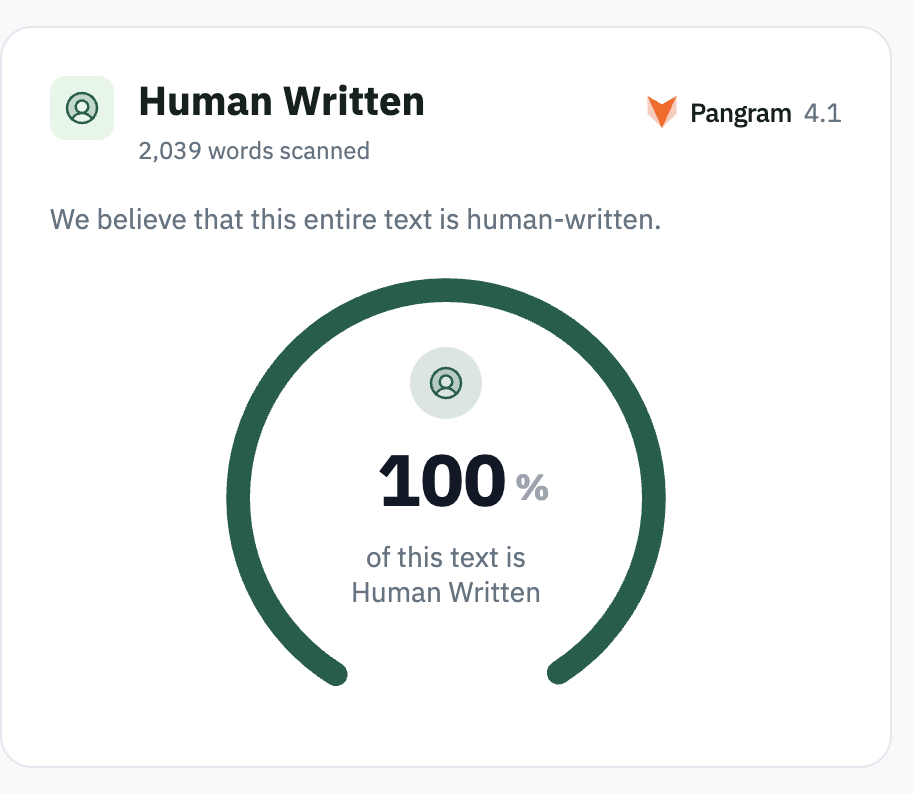
In fact, the only time it has been ‘wrong’ is when I fed it a blog post that I had used ChatGPT to generate but then edited extensively, and it came back to tell me that the post was 100% human written.
So in that sense, it has been more lenient than falsely accusatory.
I’m aware that these are just my own unscientific tests however, and clearly, I don’t write like an LLM does, where other people might.
Using AI in my writing
It seems crazy but perhaps it is necessary and important to spell out that I have never used ChatGPT or any other LLMs to write any of the text in my novels.
To do so would be pointless because genuinely the bit that’s the most fun about writing is, well, the bloody writing.
I do not understand why ANYONE would use an LLM to write a novel for them. Of all the things you can do with your time, it makes absolutely NO sense to me.
What I have done in the past however - when I was deep in my ‘omg this is awesome’ phase - is use ChatGPT to help me research things for my book.
For example, when researching the book I wrote last year (which is not being published, so this is possibly a moot confession), I asked ChatGPT to name me some hotels that overlooked the route of the Boston marathon.
I basically saw it as a super-Google, and used it for all those niggly little queries like ‘how much would an average rugby player weigh?’.
And then, everything blew up in the publishing industry around this topic, and I started to reconsider my use of it completely.
I also realised that some of my daughter’s History homework was being set using it (🙃) but the passage she was being asked to read and answer questions on contained incorrect information about the ages of Henry VIII’s ancestors - of all things.
I asked ChatGPT to double-check…
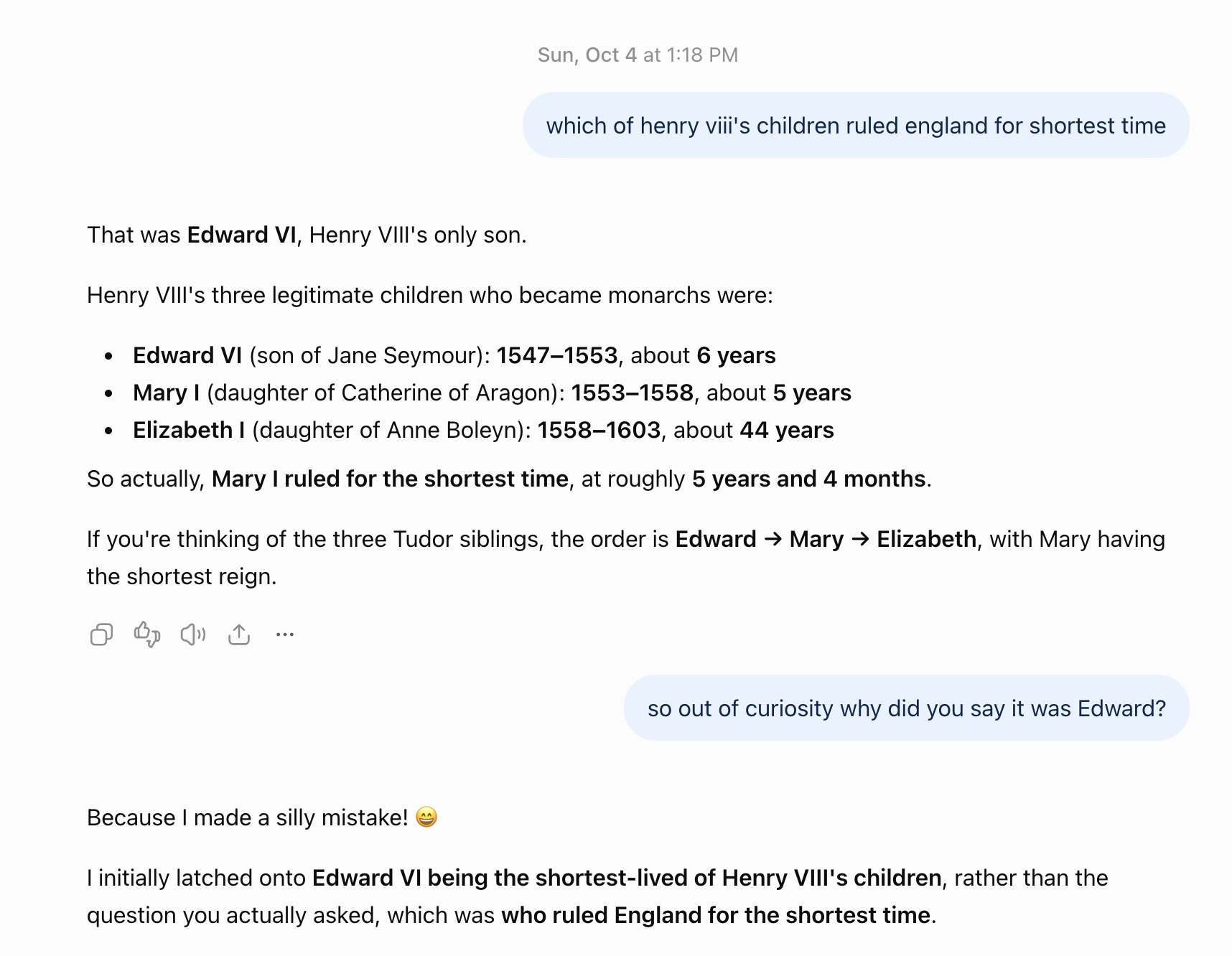
And that freaked me out. It was so confidently wrong.
After that, I lost all trust in it.
So, for the book I am currently writing, I have not used it at all. Not once. Not for research, not for brainstorming street names or character traits… not for a single thing.
For one thing, I don’t want to risk any kind of accusation that I do not write my books myself.
But for another, I have come to realise, over time, that there is more than a touch of the emperor's new clothes about the whole sorry thing.
For a while, ChatGPT seemed like this really awesome, amazing new tool, but now…
…it’s just annoying and wrong and repetitive and I hate the way it speaks and I hate the fact that it spits out reams of copy so quickly but I find myself unable to read what it says without my eyes glazing over because something in the way it writes is so completely dead and devoid of soul that I cannot connect with it or respect it at all.
Ahem.
LLMs versus other AIs
Of course, my exposure to AI so far has been mostly LLMs, but there are AI tools everywhere.
It’s like you can’t move for being bashed over the head with yet another advert inviting you to try yet another ‘tool’ that promises you life-changing productivity enhancements.
I use Canva almost every day in my web design business and I got really excited when they started to introduce their AI stuff.
One of the tools they introduced was something called ‘Image Expander’ which - as it sounds - could basically add extra material to an image.
For example, turning a portrait photo into a landscape version.
This sounded genuinely useful so I tried it with my headshot and…
it added a random little boy to the image.
WTF!
In fact, it’s so funny / random / terrifying I feel the need to share it here:
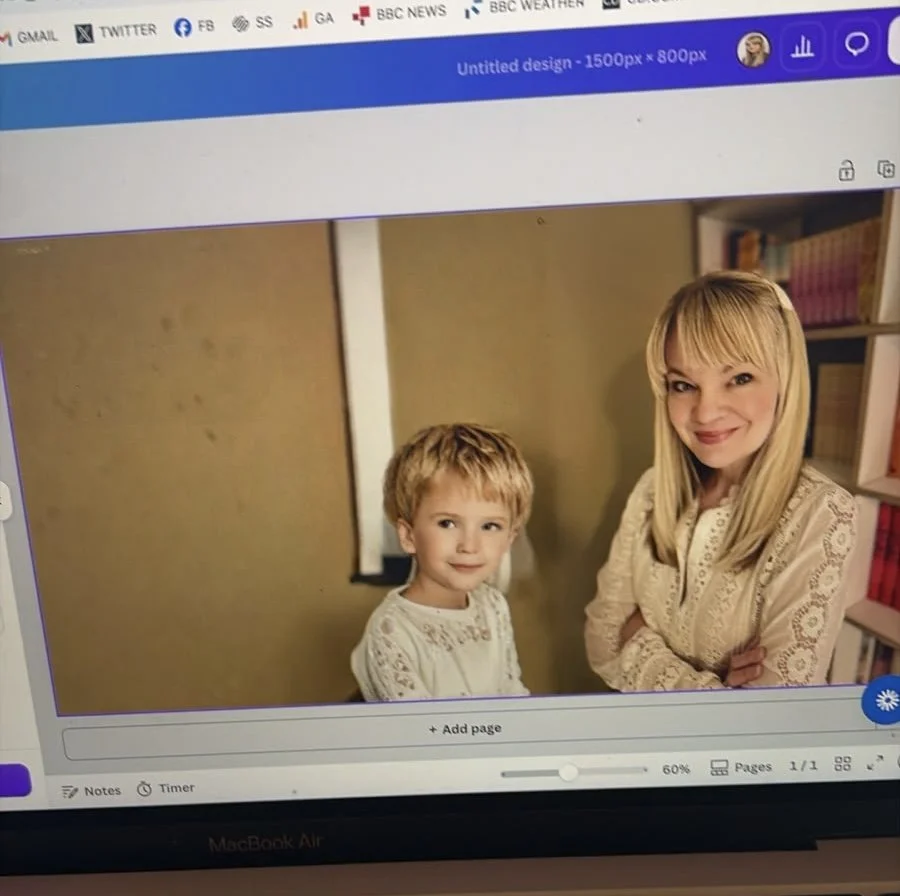
I have no idea who that boy is or where he came from? AI has clearly hallucinated me a son.
CREEPY.
And that was the end of my love affair with Canva’s AI tools. More than anything else, stuff like this doesn’t save time. It wastes it.
Suffice to say I am sure there are some really handy AI tools out there but - perhaps it’s because I’m now in my mid-forties and tired and busy - I do not have the time nor inclination to spend hours playing around with them.
I have my own systems and I can do my job with them, using the same tools I have always used. And if that makes me a Luddite then so be it.
The ethics of AI
I am not intelligent enough to formulate a convincing ethical argument on either side of the debate about AI.
It is far too complex a subject.
Of course, I hate that we’re building data centres and wasting water and all the other environmental impacts, but the truth is, I only really understand about 0.05% of the whole argument, and that is as it pertains to me and my work.
For example, did my use of that custom GPT to create code deprive a coder of work?
No, because I would not have paid someone to create the code. I would have just spent hours searching and tweaking and testing until I worked it out for myself.
Which would undoubtedly have been better for my brain because that’s how you learn.
But it would also have been worse for me because of the time it would have taken - time that I am not being paid for, time that I never have enough of.
But I also hate that people are churning out novels using LLMs. I hate that graphic designers and indeed web designers are losing work because of it. I hate all the ways it impacts small businesses and creatives in a negative way.
(And I really fucking hate AI flyers.)
I am also part of the massive Anthropic court claim because they nicked my novels in order to train Claude.
Like I said, I think the subject is incredibly nuanced.
But what I am - finally! - is decided on my own standpoint.
And that’s why I wanted to blog about it, to clarify my current position, which is to avoid using AI as much as possible in my business.
I am aware that this is highly unusual for a web designer, but I work with authors and I know that most authors feel very strongly on this topic. I want to show my support by maintaining a ‘human-centred’ approach to my work.
So, from now on:
I will not be using AI in my content creation. I will not remove previous posts created with the help of AI, but all posts from now on will be written by me alone.
I will not use AI to create content for my newsletters.
I will avoid using AI as much as possible in my web design. In select instances, I will use rudimentary tools (such as Squarespace’s built-in SEO tools, which use AI to generate metadata) but everything that is generated will be checked and edited by me.
I will not use AI to generate custom code.
All of my web designs will be built by me, from scratch, as they always have been. I do not outsource any of the process to anyone else (not even another human). I even write my own emails!
I will continue to use Canva to manually create and edit artwork for client websites, when needed, in the same way I have done for years, but I will not be using their new AI tools to generate ideas or create images for me.
If my stance on either of these things changes further down the line, then I will post again to explain.
I am also working on creating an official ‘AI Policy’ for my business, that I will add to this website sometime in the new year.
Conclusion
When I started drafting this, I put a note at the top of the blank page. It said:
DON’T NEED TO WRITE LOADS
But as usual, I have written loads. Sorry.
One thing I can promise you though is that I wrote every word myself. Mistakes and all.
Here’s to being human in all our messy, overwritten glory. ❤️
You might also like:
